Meterorites, Kneeling Beggars and a Prague Castle
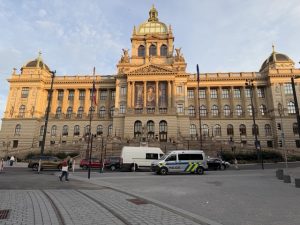
PRAGUE, CZECHIA — The Campo del Cielo meteorite weighs 83 kg (183 lbs) and was acquired from Argentina eight years ago. It sits on a pedestal in the Hall of Minerals in the main hall of the National Museum in Prague, an imposing building on the upper end of Wenceslas Square downtown, overlooking the site of countless protests and violent scenes. The main building was built in 1891, a youngster by European standards. It was renovated beginning 15 years ago and fully reopened to visitors in 2020.
The Hall of Minerals is one of four permanent exhibitions, alongside the Miracles of Evolution, Windows into Prehistory, and a Czech history exhibit. The meteorite is not behind glass. You can legally touch it. I refrain, wary of the dubious pleasures of a Prague jail cell.
(As a kid, I was a committed rock collector and wrote to state chambers of commerce across the country for rock samples.) Behind glass, I view huge chunks of amethyst, hematite, gold, and silver. There are more than 400 meteorite specimens, a dark room displaying minerals that glow under UV light — what we called black lights in my teen hippie days — and more than 4,000 other specimens.
In another hall, I come face-to-face with a snarling saber-tooth tiger, with a woolly mammoth nearby. Both are replicas, of course, but still startling to encounter around the corner. I hear the delighted shrieks of children spotting other creatures in other rooms, including a replica of Lucy, the 3.2-million-year-old skeleton now permanently housed at the National Museum of Ethiopia. Lucy spent some time in the Prague museum before my visit.
After more than two hours, I experienced “museum fatigue.” This is an established phenomenon, largely blamed on information overload. It is time to walk to the Prague Castle, about one-and-a-half miles away. I have plenty of company on this hike; tourists abound on this pleasant autumn afternoon.
|———|
The cobblestone streets from the museum to the castle are narrow and winding, largely reserved for pedestrians, though delivery vans honk their way through the throngs, headed to resupply cafés along the way. I arrive at Prague Castle and enter the vastcourtyard of the complex, which is listed in the Guinness Book of Records as the “largest ancient castle in the world,” at 750,000 square feet. Construction began in 870. The complex is the official residence and workplace of the president of the Czech Republic.
I wander outside for about an hour, admiring the lovely landscaping, the gargoyles glaring from the castle’s sides, the unblinking guards in their dollhouse-like guardhouses at the complex entrance, made more forbidding by the camo-clad soldier in the archway, holding a semi-automatic rifle.
The line to enter the castle is at least 100 yards long. As much as I would have enjoyed getting inside, I am loath to spend a few hours in line to do so. It was time to head to the Charles Bridge, a mere half-mile walk.
|———|
For centuries, the Charles Bridge was the primary crossing of the Vltava River, linking Old Town on the eastern bank with Lesser Town on the western bank, the side of town where Prague Castle is located. The bridge is one of the earliest stone bridges in Central Europe. It 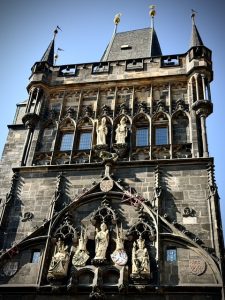 was commissioned by its namesake, Charles IV, the King of Bohemia and later Holy Roman Emperor, in 1347 and completed in 1402. It consists of a series of archways and features a magnificent entrance archway. The bridge has been restricted to pedestrians for the past 60 years. Tourists keep it perpetually crowded during the day, standing to admire the 30 religious sculptures along its railings (these are replicas; the originals are preserved in museums).
Vendors line one side of the bridge — a surfeit of caricature artists, for some reason, plus vendors selling jewelry and other souvenirs. I buy an inexpensive pair of earrings for my Beautiful Mystery Companion, who visited here 35 years ago, long before we met. I stop to admire the view of the Vltava River, a double-decker tour boat floating downstream, and ducks on the water. The crowd thins as I reach the other side and head into Old Town, where I encountered the famed Astronomical Clock a few days earlier, which you can read about here.
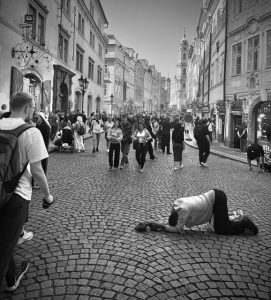
Just after crossing into Old Town, I encountered a disturbing sight — one of Prague’s kneeling beggars. A man was kneeling in a low, yoga-like position, his hands around a Styrofoam cup, his head lowered. It is certainly harder to ignore someone prostrating themselves in this way than the kind of panhandling big-city residents are used to passing by. I dropped a Euro coin into his cup, despite warnings that the kneeling beggars are managed by organized criminal groups.
|———|
 I have run out of time on this trip from Bavaria to Prague. As always on these exotic (for me) adventures, I wish I had another day to visit the Strahov Library, the Franz Kafka Museum, and other fascinating places. The sun is starting to set as I walk back to Wenceslas Square to grab a seat at a sidewalk café, order fries and a salad, and a Prague pilsner beer. This city boasts the highest per-capita beer consumption in the world.
No wonder I feel at home.
Leave a reply
Fields marked with * are required