Famed Astrological Clock Towers Over Prague
PRAGUE, CZECHIA — I embarked on a four-day solo trip to the historic capital of the Czech Republic, traveling by train from Garching, the closest station to the Bavarian village of Unterneukirchen, where daughter Mere and son-in-law Matt have lived for three years. The trip took about six hours. Luckily, I only had to change trains once. With more transfers, I could have mistakenly ended up in Budapest. I have always wanted to visit that city, but my hotel reservation was in Prague.
I figure traveling by myself in a foreign country, with its different language, protocols, and customs, is good brain exercise. Besides, it is easy to find people who speak English in Prague. Having a decent maps app is indispensable. Not being afraid to get lost in a city and to ask for help served me well.
Matt found a hotel online, a few hundred feet from the train station, and I booked it. It was reasonably priced and comfortable, with a bewildering array of breakfast foods. I avoided meat and settled on a single fried egg over a savory vegetable sauce made with peppers and onions, which was quite spicy. Loaded up, I was ready to explore.
The first excursion I take when arriving in a new large city is to buy a ticket for a Big Bus Tour, or its equivalent — any tour that allows one to hop on and off at a couple dozen stops. It’s a stress-free way to get a good sense of a city. There’s either a live tour guide or, more commonly in Europe, a recording you listen to with provided earbuds in your language of choice. I took my first hop-on-hop-off bus in London on a trip in 1997 with Mere and her older sister, Kasey. From the upper deck of that bus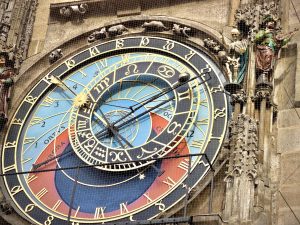 in late May, we began touring the historic sites of Central London — and promptly fell asleep. It was our first experience with jet lag. We arrived around 9 a.m., but our bodies thought it was 3 a.m.
Since then, I have learned to cope with little sleep and push through that first day. At best, I catch an hour or two on the flight over the Big Pond. I avoid driving (always a good idea in foreign places) or making important life decisions. On my most recent trip, I caught the Big Red Bus a few hundred feet from the hotel after a good night’s sleep, dodging smokers crowded along the sidewalks. In Prague, folks largely ignore the health warnings. You either endure noxious fumes or do your best to avoid them.
I hopped off at the city’s Old Town Square, between Wenceslas Square and Charles Bridge. (More on those in a later installment.) At its center stands a statue of Jan Hus, a Catholic priest burned at the stake in 1415 for criticizing the corruption and avarice of bishops and the papacy. Hus was widely popular in the Bohemian Empire, though not among those in power. This country has many martyrs, people who challenged the power structure and paid with their lives, from the 15th century through Nazi occupation during World War II and the Communist takeover after the war, culminating in the Velvet Revolution in 1989.
I was searching for the Prague astronomical clock, which has been keeping time for a few years before Jan Hus was burned at the stake. A large crowd looking up around the corner of the Old Town Hall was my first clue. The clock features two clock faces about 10 feet in diameter, with statues of the apostles, a skeleton representing death that strikes the hour, and other figures, as well as a calendar dial and an astronomical dial that shows the positions of the sun and the moon in the sky. I joined the crowd just before the clock struck 10; it was an impressive sight, a mechanical wonder more than 600 years old and miraculously preserved despite the turmoil that has struck this city over the centuries.
One can climb to the top o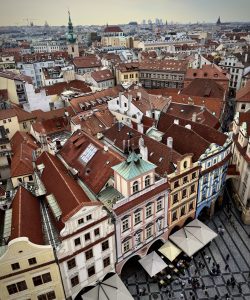 f the clock tower for a modest admission fee, about $13 if you take the stairs and skip the modern elevator. I paid and began trudging upward, a 230-foot climb. The final leg was a spiral staircase so narrow that a traffic signal at the top and bottom indicates whether it’s OK to ascend or descend. Ignore it, and someone will have to retreat. In this case it was me; I backed up a dozen windy steps to let a fellow pass.
The climb was worth the magnificent view of Old Town Square and the ci ty beyond. Prague — Europeans call it Praha — nicknamed the City of 100 Spires, is a beautiful city with a complicated past.
And the beer itself is truly worth the trip.
Leave a reply
Fields marked with * are required