Dodging Rabbit Holes at the Briscoe
by admin | July 3, 2026 8:13 am
AUSTIN — The Briscoe Center for American History at the University of Texas is located in a narrow, long row of buildings next to the LBJ Library. It is likely the only place that offers free parking at a university notorious for pricey parking rates, whether one is going to the LBJ Library or the Briscoe Center. Finding free parking anywhere in Austin is no easy feat.
I have spent countless hours at the Briscoe, beginning in 1985, when it was the Barker Texas History Center. Former Gov. Dolph Briscoe donated more than $15 million to the center, which was named for a distinguished history professor. He also donated his gubernatorial papers. The Briscoe Center, renamed in 2008, remains one of my happy places. It is good to be back.
The center was renovated in 2017 and now features a couple of galleries with rotating exhibitions. It is well worth a visit even if one is not conducting research. I am here to plug some holes in my latest project, expanding my master’s thesis into a book. It is a history of The Red-Lander, a San Augustine paper during the Republic of Texas. (That is the short version.) As mentioned previously, the Portal to Texas History at UNT recently awarded me a $2,000 research fellowship. This has given me the kick in the rear I needed to finish this long-delayed project.
I have long praised reference librarians and archivists. They are unfailingly kind and helpful. I count it as a blessing that, by the skin of my teeth, I passed the exam last summer and became a Certified Archivist.
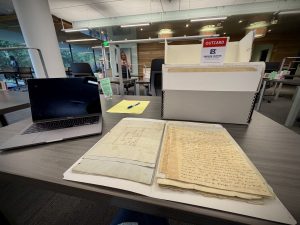
For the better part of two days, I holed up at the Briscoe, going through the papers of Oran Milo Roberts, which fill a couple of dozen archive boxes, each holding about 5 inches of files. Originally from South Carolina, Roberts graduated from the University of Alabama, was admitted to the bar, served a term in that state’s legislature, and then moved to San Augustine in 1841 to open a law practice. He was 26.
Roberts clearly had a brilliant mind and a prolific pen. In 1844, President Sam Houston appointed him a district attorney. He then held several judicial positions, including serving as a district judge after Texas becam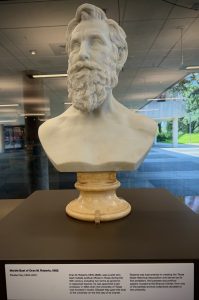 [1]e a state in December 1845. Fellow San Augustine resident James Pinckney Henderson, the state’s first governor, appointed him. Roberts then ran
for and won a seat on the Texas Supreme Court in 1856.
Then came the Civil War. Roberts was almost certainly an enslaver, though I was unable to confirm it. There is no doubt he was an ardent secessionist. He was elected president of the Secessionist Convention. While seated in the soft light of the Briscoe Center reading room, I came across a letter. As with other papers related to my project, I scanned it with an app on my iPhone. It’s a letter to the governor of Virginia, dated Feb. 4, 1861, about two months before the first shots were fired at Fort Sumter. The letter describes the Secessionist Convention and concludes: “It is the earnest desire of the people of Texas to unite their destiny with that of each and all the slaveholding states in one common Federal Union,” and is signed by Roberts.
Roberts briefly served in the Confederacy. After the war, he opened a law school in Gilmer (Gilmer!), then returned to Austin, where he was eventually elected governor twice. During his tenure, the cornerstone of the University of Texas was laid, and construction of the state Capitol began.
Readers might ask what any of this has to do with The Red-Lander, which had ceased publication by 1847. Actually, nothing. One of the occupational hazards of being an inveterate researcher is a tendency to descend into rabbit holes. I got caught up reading a prescription from 1847 for treating yellow fever. It involved a patent-medicine pill taken “till they move the bowels or till you have taken ten.” Then take a hot mustard bath. Add some quinine (which actually helped with yellow fever, like malaria transmitted by mosquitoes. I hate mosquitoes.) A lot of TMI about bowel movements follows. Finally, have a vial of laudanum handy. It contained opium and alcohol, which at least could make you forget you have yellow fever.
Oran Milo Roberts’ papers contained some useful information for my book project. Dodging those rabbit holes proved challenging but also worth the dive.
- [Image]: https://garyborders.com/pages/dodging-rabbit-holes-at-the-briscoe/oran-roberts/
Source URL: https://garyborders.com/pages/dodging-rabbit-holes-at-the-briscoe/