The Sea Lions at Pier 39, and Riding Cable Cars
by admin | September 4, 2026 7:42 am
PIER 39, FISHERMAN’S WHARF, SAN FRANCISCO — A sea lion, which I have arbitrarily named Matilda, waits patiently off the port side of the fishing boat that has returned after taking out tourists for a day casting for California halibut. About a half dozen fat, flat white halibut are laid out on the cutting table, now docked at famed Pier 39 at Fisherman’s Wharf in San Francisco. A fellow wearing mirrored shades and a ballcap, hands covered with disposable gloves, addresses a fish, quickly sawing a generous filet off its side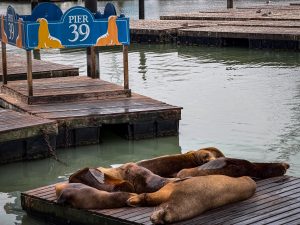 [1]
[1]
Matilda never takes her eyes off the fellow with the knife. (Disclosure: I used AI to make a reasoned guess about the gender. Fifty percent chance of being right.) Without looking, he tosses a piece of fish offal toward the water. Matilda catches it mid-air like a Labrador retriever nabbing a Frisbee. This goes on for a solid 30 minutes as we watch.
Meanwhile, on the other side of the boat, another sea lion waits in vain for scraps, ignored by the fellow cleaning the fish. That must be the male counterpart. Just saying.
Under a Pier 39 sign, closer to the bay, several dozen sea lions lounge on the decks. Their heads and flippers sprawl over one another. The sea lions resemble a litter of really large puppies, barking occasionally, as the redolent smell of fish and seawater wafted on the chilly breeze.
Of course, my Beautiful Mystery Companion and I fell in love with the sea lions. How could we not? Watching their antics was a highlight of our trip to San Francisco, where we didn’t leave our hearts behind, but we did spread credit card cheer at several fine restaurants and on several excellent adventures. This was our first trip here. Lord willing, we will return next year when the dog days roll around. There is so much to explore and enjoy, with ideal weather and amazing food.
And sea lions. These mammals live an average of 2-30 years. Males can weigh about 660 pounds, while females usually weigh about 220 pounds. They can move quickly in water, reaching top speeds of 35 mph. Sea lions can also walk on all fours. Throw in the barking, the ability to catch fish guts mid-air, and an unassailable cuteness, and sea lions rank high on the adorableness chart.
A half-dozen species of sea lions exist, including California sea lions, which eat about 5% to 8% of their body weight per day — squid, mackerel, rockfish, anchovies, and leftovers from sport fishing boats. Happily, California sea lions are not even remotely endangered, with a domestic population of more than 210,000 and steadily growing numbers. They tend to stay close to shore, providing endless entertainment for tourists.
These sea lions are noisy critters. They bark, growl, roar, and bleat both above and below water, using unique vocalizations that depend on what and with whom they are trying to communicate, according to a Smithsonian[2] fact sheet. Their fur is varying shades of brown. They sport long whiskers and big, brown eyes. Along with fur seals, sea lions are considered “eared seals. Unlike true seals, they use their front flippers to swim, while “true seals” mainly rely on their back flippers to swim.
Despite their name, California sea lions lack the “mane” one sees on other species. The South American sea lion is larger. Males sport a lion-like mane, according to online images. They look considerably fiercer than the California version, lounging about on the slick wooden surfaces of Pier 39 with their slicked-back brown fur. California sea lions are laid-back creatures.
|———|
 [3]Comedian Josh Johnson recently brought his show to San Francisco, a few days after we had left. He noted that when walking in San Francisco, one goes “uphill both ways.” We can relate after trudging the steep hills near Haight-Ashbury, the hippie mecca of the 1960s, in search of the Painted Ladies, aka Postcard Row. That is a famous row of seven Queen Anne-style Victorian houses, popular for viewing their colorful exteriors from an uphill park, with the skyline in the background.
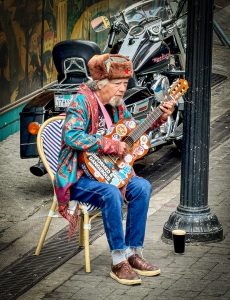
Haight-Ashbury itself was quiet on this weekday morning, fairly touristy but clean and safe. A fellow played guitar, a glass of dark beer on the sidewalk beside him. No visitors came to the Counter-Culture Museum, on one of its corners, while we were in the neighborhood.
|———|
We rode cable cars, of course. Old folks can ride for $1.50, quite a bargain, considering how steep those hills are. Eventually, we made our way to Golden Gate Park, the largest urban park in San Francisco and one of the most popular in the United States, with 24 million visitors annually. We only scratched the surface, entranced by the beauty of huge beds of dahlias, sporting dozens of colors and styles. My BMC was in her element.
From our hotel window, we could watch one of the three trolley turnarounds in the city. Cable cars can’t go in reverse, so crews get out at these spots and effortlessly rotate the cable car as it is seated on a turntable. The turntable we could see was at the base of Russian Hill, the giant neon Ghirardelli Chocolate company sign towering above it. I never got tired of watching them rotate the cable cars.
There is so much beauty here in San Francisco, so much to take in with a smattering of days at our disposal. I guess we will just have to return next August, when the dog days envelop Texas.
At least, that’s the plan.
- [Image]: https://garyborders.com/pages/7956-2/pier-39-sea-lions/
- Smithsonian: https://nationalzoo.si.edu/animals/california-sea-lion
- [Image]: https://garyborders.com/pages/7956-2/guitar-player-haight-asbury/
Source URL: https://garyborders.com/pages/7956-2/