Head ‘Em Up and Move ‘Em Out!
by admin | January 9, 2026 8:07 am
FORT WORTH STOCK YARDS – On an unseasonably warm Sunday morning after Christmas, my Beautiful Mystery Companion and I stood on East Exchange Avenue along with a few thousand other folks crowded along opposing sidewalks. (“Unseasonably warm” is quickly becoming an oxymoron in this age of climate change.) We managed to secure a spot behind the rope stretched along the street by two world-weary guys who clearly have been doing this for a long time.
“Get behind the rope, please. No sitting on the curb. You must remain standing,” they intoned, over and over.
We were here to watch the Fort Worth Herd Cattle Drive, an event that occurs twice daily except for Easter, Thanksgiving, and Christmas Day. About 15 majestic, full-grown Texas long [1]horns will be “driven” from the Livestock Exchange Building, a few blocks down and then herded back into their pens. The drive is rightly billed as a living tribute to Fort Worth’s cowboy legacy and called the “world’s only twice-daily cattle drive.” Other cities – such as Cheyenne, Wyoming, and Dodge City, Kansas – with similar bovine heritages hold cattle drives during special events. Only in Fort Worth can one see a drive 362 days a year, twice daily, weather permitting.
This is not these longhorns’ first rodeo. With about a half-dozen drovers (their word) keeping them on East Exchange Avenue and off the sidewalk, or meandering into a nearby souvenir shop (both of which have occurred, according to the announcer), they slowly hoof it down the brick street. They vary in color and horn configuration. All are huge, weighing between 1,400 and 2,500 pounds, with horns spanning from 6 to 10 feet, tip to tip.
Except for Lil’ Tex, a miniature Longhorn bringing up the rear of the drive. Lil’ Tex is “only” 800 pounds. The announcer said Lil’ Tex is quite sassy and does not let the bigger boys bother him. He will get up in their face, which made us love him even more. We always root for the underdog, or, in this case, steer.
Cattle have been run through Fort Worth since just after the Civil War, according to an entry[2] in the Handbook of Texas. The cattle, many of them longhorns known for being able to eat anything, including prickly pear cactus, were driven from South Texas northward to connect with the Chisholm Trail. The drovers would stop in Fort Worth for supplies, and the city soon garnered its most common nickname: Cowtown. By 1886, four stockyards (it is spelled as one word except in the official title) had been built near the railroad, which came to Fort Wo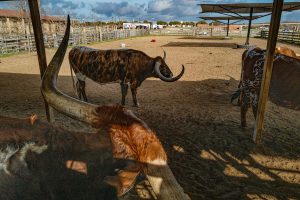 [3]rth a decade earlier with the arrival of the Texas and Pacific Railway. A fat-stock show began in 1896 and has survived until present as one of the largest livestock shows in the country.
Feedlots in the Panhandle, a pungent addition to Amarillo in particular, replaced stockyards in the 1960s. After decades of decline, the Fort Worth Stock Yard held its last auction in December 1992. The buildings now house all types of souvenir shops, western-wear stores, and restaurants. Roughly 9 million visitors show up on Exchange Avenue annually for this free event.
|— [4]
[4] 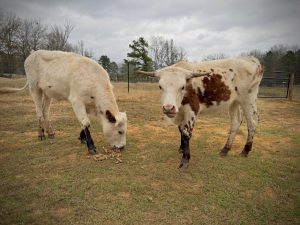 [5] ——|
I have been fascinated by longhorns since seeing Bevo on television during a UT-Austin football game decades ago. I always pause when seeing a herd of these beauties in a pasture. Before the cattle drive down East Exchange Avenue, my BMC and I visited the boys in their holding corral up by the exchange building. These huge creatures somehow have figured out how to maneuver at close quarters with 10-foot horns, gracefully ducking under each other’s racks. They are clearly used to people. A few dozen folks stood with us on a wooden balcony just above their heads.
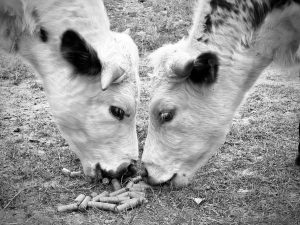
That brings me to Waylon and Willie. For my 70th birthday last August, my BMC arranged delivery of two longhorn steer calves, at the time about six months old. It was not a complete surprise but an amazing gift. She found a wonderful woman who raised them on a small ranch near Cleveland, north of Houston. We picked these two out. (They are not brothers, different mothers.) But their arrival on my birthday was a complete surprise.
Willie and Waylon (pictured in this piece along with a few photos from Fort Worth’s cattle drive) are fine additions to our critter family. My BMC has them eating range cubes out of a bucket and standing patiently while she brushes them. They dutifully trot up whenever either one of us goes down to their pen. Willie and Waylon are calm, sweet creatures, still babies at heart. They romp around in the side pasture, chasing each other like 350-pound-ish puppies. In a separate, adjoining pasture, Pancho the Donkey watches with apparent disdain. We are still looking for a jenny for Pancho, hoping it might improve his mood.
Willie and Waylon’s horns are only about a foot long. It takes 6-8 years for them to reach maximum length, from what I have read. In the next couple of years, their horns will lengthen quickly, and their direction begins to set.
That is going to be fun to watch, as was the cattle drive down East Exchange Avenue at the Fort Worth Stock Yards. Even if it was too dang hot for December.
- [Image]: https://garyborders.com/pages/7467-2/fw-stockyard-4/
- entry: https://www.tshaonline.org/handbook/entries/fort-worth-stockyards
- [Image]: https://garyborders.com/pages/7467-2/fw-stockyard-1/
- [Image]: https://garyborders.com/pages/7467-2/willie-waylon-bw/
- [Image]: https://garyborders.com/pages/7467-2/willie-waylon-color/
Source URL: https://garyborders.com/pages/7467-2/