I Miss the Sound of a Newspaper Press
I miss the sound of a newspaper press.
When I first heard a press slowly cranking up, in late 1968 or early 1969, it sounded like a lumbering beast coming awake, yawning and creaking, then slowly gaining speed until it became a roar not unlike that of a 747 aircraft. The press was in the old newsroom of the Longview News-Journal. I was a 13-year-old paperboy delivering the afternoon edition throughout downtown Longview.
The press was almost certainly a Goss Headliner, a rotary letterpress from which the pungent smell of ink wafted. Next door to the pressroom, a small contingent of cigar-chomping compositors stood over full-page steel chases, called “turtles,” assembling each page from lines of metal type and plastic halftone engravings of photos, known as “Fairchilds.”
The turtles were pressed into heavy paper-mâché mats, then clamped onto the press’s cylinders with curved, semicircular metal plates. The News-Journal’s press had at least six units, each capable of printing four pages at a time, for 24 pages per section. (Adding color reduced page capacity. The LNJ ran little process color in 1969.)
I loved to wander through both the composing room and the pressroom as I waited for my bundles of papers to peddle. If I got too close to either the composing tables or the press, grumpy men (they were all men) would run me off. I invariably returned. Watching that press crank up, and the newspapers fly down the conveyor belt to the mailroom was magic to me. That magic lasted about 50 years. It was a damn fine run.
After a few years as a paperboy and a brief stint in the mailroom stuffing circulars into papers, I became a part-time photographer at the LNJ. A major part of my job was operating the Fairchild engraver mentioned above. A photograph was wrapped around a cylinder, and a piece of blue plastic was wrapped around it as well. As the cylinder spun, a photoelectric eye scanned the photo and translated the image into a red-hot stylus that burned halftone dots into the plastic, creating the photographic image. (Halftone dots reproduce the grayscale of a photograph. They varied in size to mimic the variation from white to black in a photo.)
The Fairchild engraver moved slowly, taking about five minutes to finish a photo. I would remove the plastic engraving from the cylinder, take it to a sink, and scrub it to remove the soot from the stylus. It was a smelly, dirty job, but it beat stuffing circulars in the mailroom. Besides, sometimes I was allowed to go out and take photos. I was 15.
 |———|
|———|
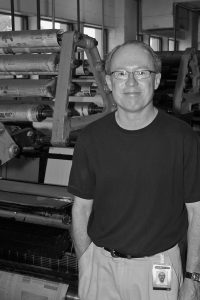
About 20 years ago, National Public Radio on All Things Considered aired an occasional series called Sound Clips. Listeners could record and submit short clips of sounds they enjoyed, such as monkeys chattering in Maui, an old English organ in Rhode Island, or the sound of rattlesnakes in the classroom. Seriously. On a whim, I submitted a clip of the press at the Lufkin Daily News in operation. I was the publisher at the time. To my considerable surprise, NPR readily accepted my proposal and arranged for a producer to help me provide a higher-quality clip and a brief intro. (Like everything I do for NPR, this was a labor of love, not for money. OK by me.)
Listening to it nearly 20 years ago is a bit sad and nostalgic. Perhaps I had been overly optimistic then. You can listen to the clip here. Since then, there has been little dispute that the newspaper industry has been clobbered, though it remains a viable business — just far more financially challenging. (I still write the weekly Capital Highlights column for about 100 Texas newspapers.)
One of the most significant areas of consolidation has been in printing operations. Newsprint consumption has fallen by 75 to 80 percent over the past quarter-century. That means newspapers and other newsprint users (like the National Enquirer) are printing up to 80 percent fewer pages than at the dawn of this century. I no longer regularly read print newspapers, though I still subscribe to about a dozen online, from my hometown News-Journal (where I first saw a press in action) to the Boston Globe, New York Times — and all the Texas metros — to gather snippets for my Capital Highlights piece. (When I visit an unfamiliar place, like my recent trip to San Francisco, I still shell out a few bucks for a print copy. Nostalgia, perhaps?)
|———|
I believe print newspapers will be around for years to come, just not in as many numbers. Who knows? The nostalgia kick that drove a resurgence in vinyl records might create markets for retro newsprint products. Opportunistic entrepreneurs are still launching new print products, such as Community Impact, which is mailed to homes across Texas and beyond and produces 35 editions covering 65 communities. Other folks, like a colleague in Lufkin, are creating similar products. Check out The 936 by clicking here. It is absolutely necessary to have a robust digital component if a publication is printed only weekly or monthly.
Maybe someday I will get to hear a newspaper press cranking up again. If not, I can always listen to that NPR clip or rewatch The Paper, Citizen Kane, or All the President’s Men.
Leave a reply
Fields marked with * are required